Monday, February 16, 2015

Great discussion on shotgun proteomics false discovery rates from BioCode's notes


Oh FDR, how I love thee....and how I wish I'd taken more maths in college....

In BioCode's notes, one of my all-time favorite blogs, Yasset walks us through his thoughts on shotgun proteomics FDR, in particular, how we can look at FDR in tools readily available in PERL.  This isn't an early morning read...at least not for me...this is one of those post-lunch full of caffeine reads.

You can check it out here.

Saturday, February 14, 2015

It might be time to take another look at PEAKS


I had an insanely busy but extremely productive week at the Mayo Clinic.  One of the highlights of the trip was the chance to pop in on my good friends at the MPRC.  The MPRC has that perfect combination of things that we all want where we work:  access to cool samples, cutting edge instrumentation, and a load of top notch scientists to run everything.  Popping in is like Xmas to a nerd like me.

Of the many things that I learned in my few short stops in is that I really need to find some free time somewhere to check out PEAKS 7.  I know a lot of you out there have a copy of PEAKS sitting around.  In the earlier versions you could argue that the interface was maybe a little wonky or the FDR didn't seem quite right.  Honestly, I'd probably have said the same thing, but I really need to do de novo sometimes and PEAKS has always been the easiest interface out there.

I saw QE data ran through PEAKS yesterday that knocked my socks off.  The PEAKS interface is more intuitive (and more useful!) and the data we were looking at was just perfect.  I don't know how the licensing thing works, but I think if you've got a copy you should see if you can demo the new version or get yours upgraded.  I think you'll be impressed.


Friday, February 13, 2015

sbv IMPROVER. Got time to compete?


Thanks @PastelBio for this super interesting link!

sbv stands for System Biology Verification.  What it appears to be is a consortium (this is the word I use when I don't know who is doing something cool and they've got a great website) that wants to improve how we do biology.

The way it works is they set up challenges, kinda similar to what ABRF sets up, but they do this for all sorts of biology. A biological pathway analysis challenge is currently underway and they recently wrapped up a couple phosphoproteomics studies.

Check it out here!


Thursday, February 12, 2015

Exact m/z of the Pierce PRTC peptides


I'm throwing these up as much for you guys as for me so I can reference this later!

Here are the exact theoretical m/z for the Pierce Retention time calibration peptides:

Theo. Sequence Theo. MH+ [Da]
1 SSAAPPPPPR 493.7683
2 GISNEGQNASIK 613.3167
3 HVLTSIGEK 496.2867
4 DIPVPKPK 451.2834
5 IGDYAGIK 422.7363
6 TASEFDSAIAQDK 695.8324
7 SAAGAFGPELSR 586.8003
8 ELGQSGVDTYLQTK 773.8955
9 GLILVGGYGTR 558.3259
10 GILFVGSGVSGGEEGAR 801.4115
11 SFANQPLEVVYSK 745.3924
12 LTILEELR 498.8018
13 NGFILDGFPR 573.3025
14 ELASGLSFPVGFK 680.3735
15 LSSEAPALFQFDLK 787.4212

Shout out to Tara, cause I'm pretty sure I stole this from a slide deck you made!

Wednesday, February 11, 2015

MitoFates: Predict your cleavage products.


I'm currently processing the 16 files I ran overnight.  All human stuff. All pretty well characterized.  As always I find myself wondering things like "what the hell are all these MS/MS spectra that don't match anything!?!?!"

Peptide match on the Q Exactive allowed them to fragment, so they clearly have peptide-like isotopic distributions.  They have charges from +2 to +7, so I should be able to sequence them effectively.  It is a cancer cell line so I could do some tricks like using the XMan database to find the known mutations and that always pops up some new peptides.  I can run the file through Byonic and find PTMs and some novel mutations, but I'm still looking at a bunch of spectra that look nice, but don't match anything.

A while back I was blown away when I saw a talk describing the well-known (not to me...) facts of how systematic apoptosis cleavage events can be.  Even in cell culture some of these cells are going to be dead or dying or whatever, so could that be some of it?

To make the biology even more complicated, you can drop your proteins of interest into the new MitoFates program.  MitoFates will then search your proteins for known cleavage recognition sites and generate you a new FASTA.  So if programmed Mitochondial degradation is occurring you'll be able to identify the peptides that are caused by those events.

You can read about MitoFates (in press at MCP) here.

And you can just go ahead and dump your proteins in here!

Tuesday, February 10, 2015

Top tip -- fractionate your samples dozens of ways with your centrifuge


I just heard about this today.  Top Tip is a product from GlySci.com.  At first it seems kind of boring.  "Fractionate your peptides without an HPLC?  Big deal!"  Then you take a look at the number of chemistries you can use.

SCX?  Check
SAX? Check
WCX (whatever that is?)? Check!
Two kinds of IMAC? Double check

The list of available resins is seriously a page long.  You can check it out here.  I haven't used them, but they got a good endorsement from a guy who is probably better at this proteomics stuff than I am.  And I'd rather pipette or spin to fractionate than set up an offline HPLC fractionation!

Monday, February 9, 2015

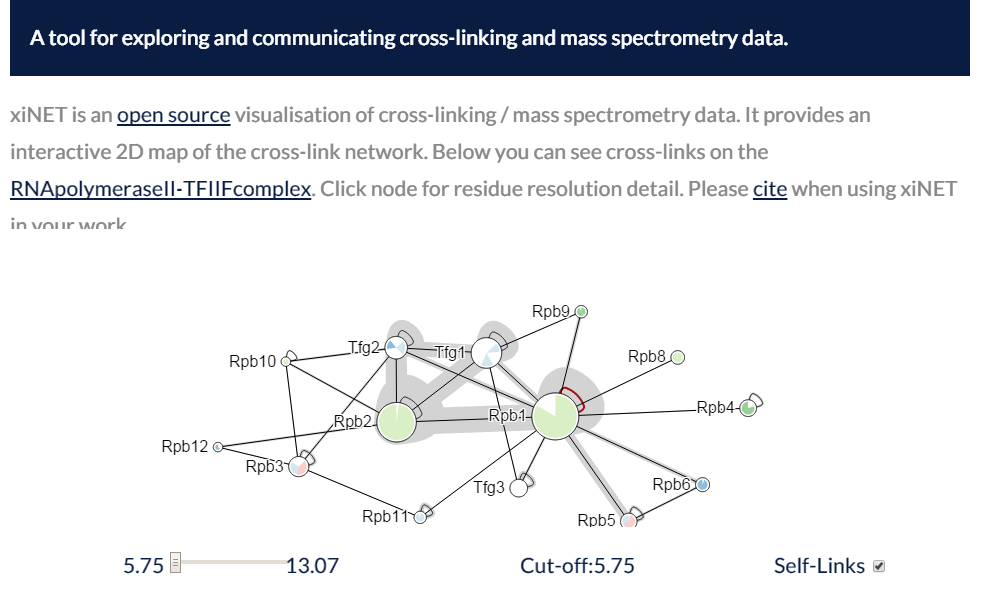
xiNET Cross Link Viewer


Okay!  I totally dig this one!

XiNET is described above in the screenshot that I cut from the main website.  You can pop over to check it out here.  Or you can just go to crosslinkviewer.ORG.

If you are one of those weird Bioinformatics-focused people, you can actually get all the source code to download and check out from GitHub here.

The paper from Colin Combe et. al., is currently in press at MCP here.

Now that all the links are out of the way, what the heck does this thing do?  Well, you feed it a CSV file of your crosslinked peptides.  Presumably you found them using something like the X-comb or Byonic, then you give it your FASTA database (or it uses a recent Swiss-Prot) and it generates you awesome graphics of these cross-links your mass spec found for you AND gives you some level of statistical significance of these crosslinks!  The paper works through some historic datasets and shows how well the xiNET works through this data.

This is a nice new (and surprisingly, it appears, easy to operate...at least in the web interface!) tool for anybody out there doing shotgun analysis of protein interactions.  If this describes you, you should definitely check it out!


Saturday, February 7, 2015

Thursday, February 5, 2015

Why you should run your nanospray at lower voltage


This is pretty cool.  You know, we always try to get our nanospray voltage to the lowest energy that will provide stable spray.  Why wouldn't we just set it higher?

Well, I think this great picture I got to take yesterday at the University of Wisconsin illustrates the point.  This is an EasySpray source running the same peptide (same scale) at different ESI voltages.  Check out the oxidation peak that shows up when you crank up the electrospray voltage to 2.35kV!  Crazy, right!?!

Thanks go to Greg for collecting this data and letting me share it!

Monday, February 2, 2015

Omics Tools. Well-organized omics resources


This is just an incredible repository of info and direct links to tools.  No idea why I've not seen this before.  You can check it out here (omicstools.com).