Friday, December 15, 2023

Immunopeptidomics in the era of single cell proteomics!


Ultimately, most methods for doing immunopeptidomics are intrinsically flawed (stupid) because you're often introducing these completely fictitious (stupid) situations to produce lots and lots of peptides.

You grow funny cells that overexpress the few classes of HLAs that those (crappy and haven't notably improved in enrichment or discriminatory power in over a decade) antibodies can pull down. And/or you take your cells and you grow 4,000 gallons of it and cross your fingers and hope that you still maintain the same surface peptide expression.

The real goal of almost all immunopeptidomics is to take a single biopsy from a cancer, find that it has some very specific signature on it and then rain all the hellfire of modern medicine down on that cell type. CAR-T or bispecific antibodies or super charged poison warheads fused to antibodies. 

But we've never ever had enough material for that. We've had to do the other (stupid) things. 

But...all the sudden sample prep, HPLCs, and high res mass specs are all scrambling for more and more sensitivity so that we can go out and say "look at how many proteins I can count in a single cell!" 


Are we there yet?????!!?!?!?!?! I hope so, but I'm scared to hope too hard, but this perspective has a lot of optimism in it! 

Thursday, December 14, 2023

Do you have an LTQ or LTQ Orbitrap with a nanoLC on it? Wanna do an easy collaboration?


Hey Proteomics world! I have a bad idea I'd like to test and no one around me has an old instrument that I could test it on. I was considering pulling our LTQ Orbitrap out of surplus but they're really freaking heavy and switching it from MALDI to ESI takes foooooooooreeeeeeeeeeeever. 

Do you have an LTQ or LTQ Orbitrap of some kind with a good splitless nanoLC on it? Actually, I don't think a Waters HPLC of any kind would work for this idea, due to the side cut on the needle. Would you like to help me test a bad idea? If so, I can make someone prepare samples! 

orsburn@vt.edu

Transcriptomics and spatial proteomics by IHC for missing proteins in the human ovary!


Hey! This is all RNASeq, single cell seq and boring old immunohistochemistry! And, you know, what? It's an impressively constructed argument that adds about 20 proteins to the human ovary that we didn't have any protein level evidence for before! 


BTW, does anyone know of a snipping tool equivalent for MacIntosh? This whole "make a super high res screenshot and upload it to google thing" slows me down a lot more than it should. What was I....oh it uploaded! 

So the human protein atlas (www.proteinatlas.org) obtained new material from ovary/oocytes across a range of ages and they did RNASeq and came up with a bunch of transcripts for things that there is no protein level evidence for. They did "high resolution" IHC (which is basically fixing thin tissue sections to slides, fixing with formaldehyde or something similar, permeating [been a long time, I forget the order you do this stuff] binding with antibodies and then doing microscopy). It's high resolution if you've got a better microscope than those bums down the hallway. When they upgrade to something better than yours, then it's ULTRA HIGH RES, and then you're on your own to come up with a name for it when you get that S10 to get something even better. However...actually....you could listen to PowerMan 5000 for inspiration, I guess. 

Worth noting, there is lots of meta-analysis of the existing human protein atlas (HPA) in this paper - also worth noting, a lot of the "protein expression" in the HPA is based on transcript abundance with correlation to IHC. That's why when you get a visualization of the expression of a human protein across various organs you get Starbucks terms. Which one is bigger, Vente, Grande, or Impreza? Sometimes helpful, though, but caution is advised. 

What is cool in this study is that there are rarer cell types here and expression of proteins in these cells were previously below the limits of detection in the HPA. This study employs single cell RNASeq, which I presume is done by extracting the nuclei (which is an awful lot of scSeq on humans, btw). When they correlate their high resolution IHC which can visualize the antibody binding at a single cell level, it matches up well with the single cell seq. 

I'm fuzzy on how they got their antibodies, and I already typed too much today, but this is a short read on proteomics techniques that are really easy to do if you've got a decent microscope and some patience. 


Wednesday, December 13, 2023

Weird PTMs in Kupffer cells!


We've always found the liver to be pretty boring from the context of the easy to detect PTMs. Kupffer cells, which is a made up word that can only be written (and NEVER SAID OUT LOUD) are one of the cell types in the liver.


Turns out there ARE PTMs there! These people found a bunch of acylations!

Hmmm....okay...these are immortalized mouse Kupffer cells....which is still cool, but I do think that maybe there should be some caution in extrapolating these results to a more normal terminal cell type. The proteins were extracted, digested and anti-acylation antibodies were bound to beads for the enrichments. 

Interestingly, the enriched peptides were separated on C12 columns they packed in house, which I thought was a typo, but that's what they were. Despite what the illustrations in the manuscript suggest, an Orbitrap Velos was used for analysis, but most of the instrument method, -like whether the MS/MS spectra were high resolution or ion trap spectra - is a secret the authors chose to not divulge to readers anwhere in the manuscript. If you're actually curious, the data is publicly available. I am curious because the localization of a lactylation on a lysine would be a little more exciting to me if the fragmentation spectrum for the PSM was a high resolution accurate mass one. However, a stellar student in our program is defending today and I need to get in my car. The secret of the instrument method will remain unsolved. 


Monday, December 11, 2023

Hypothesis shot down by one of the greatest proteomics papers ever! Typo??

EDIT - This post was updated on 1/1/2025 to fix some really funny errors thank to my career defining dysgraphia/dyslexia. 

Okay --- so I seriously think that something I'm looking at is a weird PTM that I'd never heard of before, which is a hydroxyproline.


However, the ProteomeTools project shot that down. They synthesized peptides with this mod on it and demonstrated that there is a very specific diagnostic fragment ion at -- 

In one of my very favorite papers of all time. Something that gets the crap cited out of it because it is AMAZING. You know it, but here it is anyway. 

And I don't see a matching fragment.  I see something close, and I checked my calibrations but it is definitely 171.076 something and I'm not running instruments here that can't tell 0.011 m/z apart. 

Because I'm stupid and had time during a seminar I went to PRIDE and downloaded the RAW files for this mod and I extracted the diagnostic fragment ion for 171.067 - and got an empty XIC. 

What? Right??  So then I extracted for 171.076 and BOOOOOOOOOOOOOOOOOM!!! A bunch of peaks! 


There was a small typo in the tables in the supplemental and that typo made it's way into the table and I think I've got a cool mod to show people that might explain why some proteins are being weird! 

Sunday, December 10, 2023

Strangely inaccurate review of proteomics technology in MCP? WTF?


There is a long standing blog rule about the fact I already get hundreds of emails/day and it's better if they're mostly positive things or people asking me to run 1,000 plasma samples for free. 


The MIRIADE Consortium appears to be a rather new group of neuroscience investigators in Europe who appear to have good intentions and tried to put together a review of a lot of ways to measure proteins and have never been in a clinical chemistry lab or know anything about them at all, or they included too many authors and everything got lost in committee? Either way, someone should point out that this is not an entirely accurate review of the powers and limitations of LCMS technology in this context. This isn't a "mass spec is the greatest technology ever" bias from my front, it's that the mass spec descriptions are simply wrong. I was hoping maybe the figures downloaded wrong, like they were linked tables that came down in the wrong format, but I don't think that is the case. 

Saturday, December 9, 2023

Organ aging proteomic map shows the days of LCMS for proteomics are coming to an end!

For an actual breakdown of this study after I had time to read this work thoroughly (thanks RSV!). There are a lot of assumptions that should be discussed and, disappointingly, the work was somehow published without making the original data publicly available for scrutiny by others. 

While I'm not that surprised to see restricted data access for SomaScan technology (old post here) it is disappointing at this tier of a publication. 


This is probably the biggest proteomics news story that I've ever seen. How many outlets are running with this thing? 


LCMS? Nope! Some fancy old technology that it's fun for us to laugh about due to lack of analytical precision, proven quantitative values, and clearly based on error prone technology -- I'm not even going to look and see if this is an antibody array antibody bound to a oligonucleotide or an aptamer or whatever.  It doesn't matter. We know that the input is garbage compared to LCMS. But that isn't what matters -- what matters is that with the right informatics that has been fine tuned from decades of working with the 99.9% useless random noise (real number) that is Illumina data, these people can extract great stuff from it! 

Friday, December 8, 2023

...so...don't use acetic acid if you are using a trap column!


Since I've been even more short-handed than usual that last month, I've had to get some weekend time in the lab around grants and hunting a permanent position. Funny story that is probably obvious -- on a PepMap trap, 0.5% acetic acid causes an impressive lost of the more hydrophilic peptides! 

Actually, what I'm talking about is this original work

and my work that suports these findings

While it might seem crazy to be even trying to use a trap for ultra-low input or single cell proteomics, Claudia Ctortecka has shown some great data in recent talks that having a higher volume sample pickup + trap improves the reproducibility from sample to sample (vs trying to pick up half a microliter or whatever your autosampler can do). As crazy as that sounds (sample loss by trap, right??) on a normal 0.1% formic acid EasyNLC pepmap setup, it seems to work in my hands as well -- 

Till you wash that trap with 0.5% acetic acid.... (spectronaut presursors shown per cell/library free/30 min LC method at 300nL/min) 


I tell you what - Microsoft has the clear advantage of the Snipping tool for this kind of stuff. What I'd like to do is circle all the cells on the left side of that thing above and write "formic acid" on them. There is a gap in the middle where there are two empty cells - those are method blank controls, and then the right is the acetic acid trapped cells. The next to last one doesn't look that bad.

I already tried a different plate of cells just in case there was a bad plate, but it looks pretty consistent that the acetic acid trapped cells are missing a lot of stuff in the early elution range. 


Screenshot grapped from DA - the green is the acetic acid trapped peptides - later in the signal intensity looks really similar in this run, but look at how much less complex it looks vs the one formic acid run in purple. 

Weird, right? 

Monday, December 4, 2023

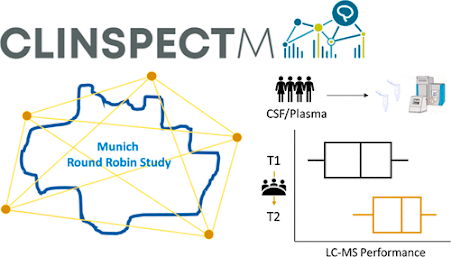
Multicenter (multi-instrument) plasma and CSF clinical collaborative study!


You really do have to read this one mostly awake to figure out what the graphs mean here, but it is a super interesting and inspirational study. 

Basic idea, though, is that all these labs received the same samples and they ran things the way they normally do. Some use in-gel digestion, some used SP3, some used EvoSep+ Exploris or Tribrid or TimsToF+ NanoElute, the U3000 and the EasyNLC all make appearances. You see DDA and DIA. 

Okay, so that just sounds like an ABRF style competitive study, right? 

Then the results were processed and all the labs got to compare notes and run again. 

T1 is labs doing their stuff without anyone else's notes and T2 is after getting a chance to see the other data/results/methods.


There is tons of insight into this paper, btw. Like - there is still a lot of in-gel digestion occurring. How does an Exploris or QE HF compare to a tribrid or TimsTOF pro? Now, there are a lot of apples to ardvark comparisons, though. An EvoSep generally runs at a higher flowrate than a NanoElute or EasyNLC and probably a U3000. 

To keep everything even on the data analysis side all the files were processed in MaxQuant, whether DDA or DIA. 

Encouraging thing #1: Whether CSF or plasma, the results are pretty similar despite what sample prep, LC or mass spec people are using. That's pretty cool, because the QE HF is 7 years old? Crap. It's almost 10?? 

Encouraging thing #2 (the big one): When proteomics labs share notes, the results universally go up! 


Friday, December 1, 2023

THE Proteomics Show Season 3 is go with Professor Lisa Jones!


Lydia Bradshaw made this great new Season 3 logo! I knew shows were going to start posting, but I didn't know when, and my phone just told me it's today!! 

For this season we're interviewing whoever US HUPO tells us to. Mostly people fancy enough to get invited to speak at US HUPO without even having to submit abstracts! There will be surprises - like - proteomics people who don't use mass spectrometers!