Monday, April 28, 2014

qcML: an exchange format for quality control metrics from mass spectrometry experiments


More quality control software solutions!  You know how I love this stuff!  I'm about to board a plane to Cambridge for the PD 1.4 workshop so I'll admit I haven't read this all the way through, but what I've read, I like.

qcML is described in this paper from Waltzer et. al., and is currently in press (and open access) at MCP here.

I'd describe it, but I'm in a rush and this stolen image describes it pretty well!

Lets all do quality control!  Not so much that we don't get experiments done, but enough that we know that our data is always good.


Sunday, April 27, 2014

100,000 views?!?!! What?


Short entry, as I'm pretty jetlagged.  But while I was on vacation, the blog hit 100,000 views!  Holy cow.  Thanks for reading, everybody.  And thanks for all the great comments that have been and keep rolling in!

Friday, April 25, 2014

Need another easy high yield digestion method? Try sTRAP!


Recently, I've heard of a number of a few groups who have had trouble with getting good peptide coverage using the FASP method.  I'm still a big fan, but I realize that we might be trading reproducibility a little for sample digestion efficiency. There is obviously room, however, to improve on the FASP method and there are a lot of new variants out there.

In this month's Wiley Proteomics, Zougman et. al., go a completely different direction with their method, STrap.  The method still seems relatively easy but maybe more robust than simple FASP.  the article is open access (with Wiley registration) and worth checking out.


Thursday, April 24, 2014

Malaria proteomics -- no mass spec necessary


Cool new paper in EUPA Proteomics.  This comes from Bachman et. al., and details the use of a protein array to study over 1,000 proteins in children with varying degrees of malaria.  They end up finding a number of known and somewhat unknown (muscle proteins? weird) proteins that appeared differentially regulated with malaria severity.


An overview of the method employed is above.

Wednesday, April 23, 2014

SpliceVista. Find your sequence variants


More than 90% of Human genes have been found to have splice variants.  Since we're still looking at the same old Uniprot, we miss most of them.

Enter SpliceVista from Yafeng Zhu et. al., from Karolinska (grab it while its still open access).  Oh, and download it from GitHub here.

Whats it do?  It grabs splice variant data that has been compiled by awesome new sequencing technologies and makes a new peptide database to compare your MS/MS spectra against?

Does it work?  Sure looks like it!  They process some acquired data and pull out almost a thousand MS/MS spectra that can be explained by splice variants, several of which are known to occur in these cell lines.

Lets figure out what all those unmatched MS/MS spectra are.  They can't all be contaminants!


Tuesday, April 22, 2014

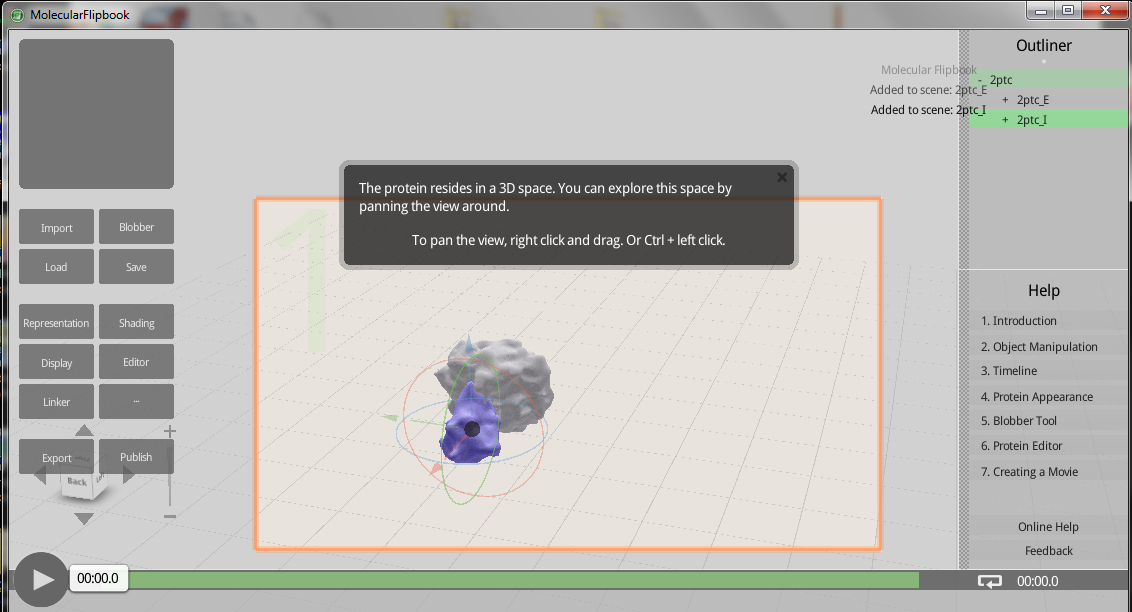
Molecular Flipbook! Free 3D protein modeling


Want to do 3D protein modeling?  Just need a reason to buy cheesy 3D glasses from Amazon?  Then I have a program for you!  The Molecular Flipbook can do this for you.  Directly upload proteins from the PDB.


You can read more about this software, as well as how to download it here.

Credit goes to Brenda for finding this one!

Thursday, April 17, 2014

Its official! My first ASMS!


Officially registered!  After a decade or so in the field, I've given up.  I'm a mass spectrometrist.  There, I've said it.  And as such, I should probably go to that thing y'all are always talking about.  This year its almost literally in my back yard so I don't have much of an excuse.

See y'all in Baltimore, Hon!

Wednesday, April 16, 2014

wiSIMDIA -- the ultimate quantitative technique?


We all know the Fusion is fast.  Crazy fast.  And we know that the Fusion has some FTICR level resolution capabilities (though much faster).  What if the crazies out at the Thermo factory decided to re-approach DIA (sometimes called SWOTH, or something) and utilized all of the powers of the Fusion to negate all of my complaints about these approaches?

Well, you'd probably end up with this technique described in this application note.  I cut the core experiment description about above.  Here is the gist:  you do SIM at 240,000 resolution (1/4 million!) and break it into 3 largish windows.  So you start with the depth and sensitivity of a SIM scan.  At the same time, you have the ion trap do little DIA experiments of 12 Da windows, so you have the specificity of tiny DIAs on top of the dynamic range and specificity of big window SIMs.

If you bring me data where you show me your peptide of interest resolved at 240,000 resolution, 99% of the time I'm going to say "sure, that's your peptide" if you can back it up with 8 fragment ions from your DIA (which is the default quan method that this method uses!!!!!) from the same freaking experiment, you've identified that ion without any shadow of a doubt.

This method will be a default template in the next release of the Fusion software.

Update 4/16/14:  There appears to be a problem with the graphics on the link above.  The original PDF of the application note is available on Planet Orbitrap.


Tuesday, April 15, 2014

Virginia Tech still kicks ass!


When I chose Virginia Tech for graduate school I did it for 2 reasons, 1) Virginia Tech is a kick ass research school and is consistently one of the best science/engineering schools on the East Coast. (and 2) cause I love mountains! and it is one of the most beautiful locations I've ever seen in my life.

I was there seven years ago when a little prick took a gun and shot a bunch of nice people having class.  As bad as that was, something that makes me almost equally angry is the fact that one day has almost overshadowed the fact that this is a premier research school.  Prior to April 16th, 2007 Googling Virginia Tech would take you first to the school's rankings (and then to the football program). Since, it shows you first pictures of that little shit.

Off my soapbox, I'd like to use today's entry to remind people that Virginia Tech kicks ass and we need to forget about what-his-name.

As evidence, I'd like to point out that VT dumped $450M into research in 2011 (the newest numbers I could find).  That places it cleanly into the top50 schools in this country.  I'd also like to point out that, although it isn't super high on the NIH research institute rankings, tons of this money comes from private enterprises, but we also pull in the federal funding:


Dr. Chang Lu wont this NIBIB award this week to develop assays using as few as 100 cells to track disease progress.  

Dr. Lu's grant will add to these numbers from last fall from the Carilion Research Institute (which didn't exist way back when I graduated).


SO.  I'm getting off the soap box for real, and getting back to the science, but what I want to leave you with is this thought.  The next time you think about Virginia Tech, think about a great school with a history and record of success in all sorts of research areas (and that appears more successful all the time) and not about something unfortunate that happened there.  I don't want to ignore that event, but I don't want it to be all we consider when we hear the name of that awesome place.

Now all we need is some Orbitraps in there (don't worry, its one of my side projects.)

Monday, April 14, 2014

Assessment of MS/MS Search Algorithms with Parent-Protein Profiling


Okay, this is pretty smart!  This paper is in this issue of JPR and from Miin Lin et al., at Wesleyan Connecticut.

There is inherently some uncertainty in the assignment of peptide/protein ID from shotgun proteomics data.  What if we had a metric for it?  In a decidedly old school and awesomely valid way of looking at it, these researchers went back to the tried and true molecular weight determinations from a nice old SDS-PAGE gel.
They cut slices so they knew the parent protein molecular weight, but dumped that data for now.  They then used a slew of search algorithms with a 1% FDR and went back to see how well their peptide IDs corresponded to their molecular weights.

I think there is a possible criticism of this technique based on unknown cleavage products and post translational modifications causing shifts in the molecular weight of the protein or in the charge, and therefore shifting the pattern of protein migration.  I would counter that argument by stating that I would expect this would be relatively minor in comparison to the high abundance proteins.  I'm sure cleavage/PTMs have an effect but I don't think it hurts what an elegant analysis this is.

What were the conclusions?  That using multiple algorithms give you a better shot of matching the expected protein identity.  So, if you haven't been convinced already to use as many processing algorithms as practically possible to dig through your RAW data, here is yet another data point!